
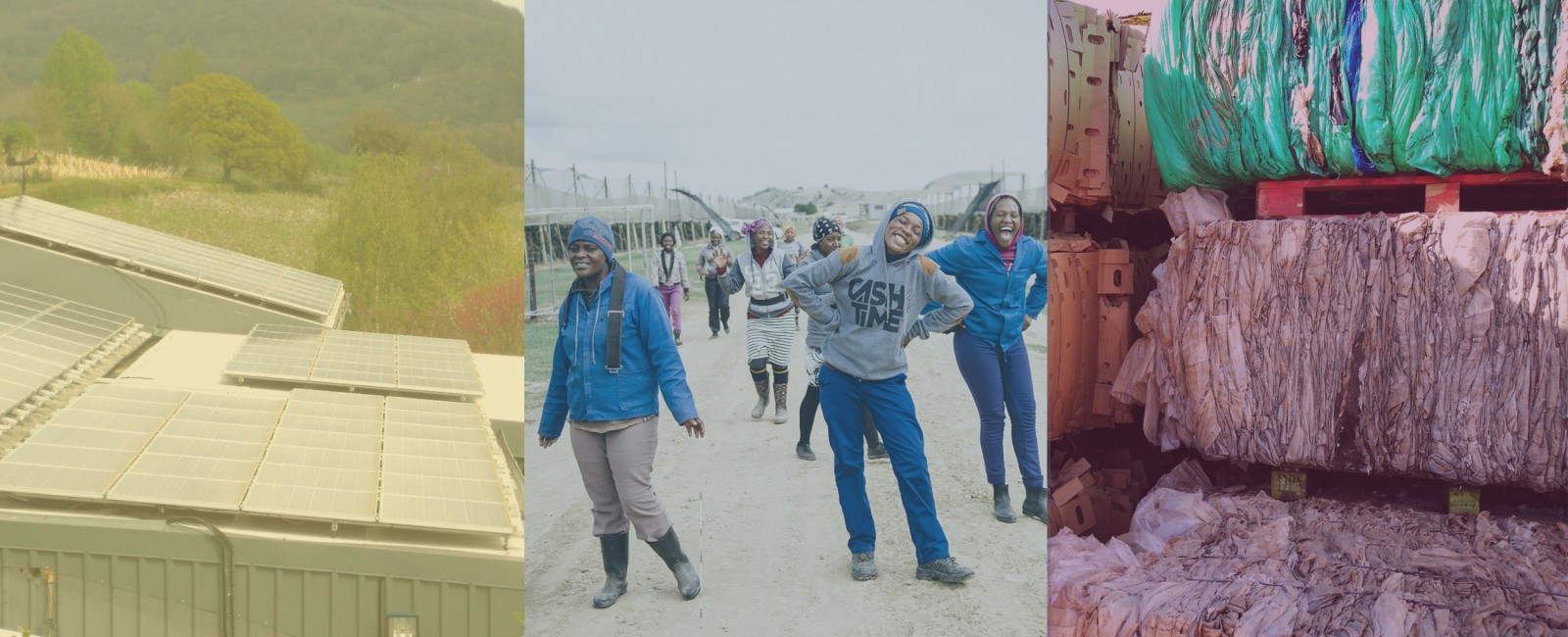
Triple Bottom Line

We’re generally people who like to “do it” rather than talk about it, however we have been persuaded to explain our motivation. We are not about more hectares, or more polytunnels and growing systems. Haygrove’s reason for being is:

  1. To create opportunities for great people, particularly those who have drawn the short straw.
  2. Move minds as to what defines a great business.

These self-set challenges are based upon belief that:

  1. Ignoring the billion people who are at the bottom, now holding smart phones with near-free internet, could be the biggest mistake our children suffer. In this newly connected transparent world the challenge to us all to provide each other genuine opportunity to improve our lot, whatever it is, is becoming increasingly vital (frustrated people smash windows).
  2. We have a planet into which all sensible people are saying we must stop pumping carbon.
  3. Working just to earn money, dominate a sector, or gratify ourselves, seems to pale in relative importance in the face of these realities. How we live seems critical, but also useful impact seems excitingly more achievable.

How does a medium-size business really make any difference?

In the last 30 years, the vast majority of the world has chosen to organise itself around money and business. Governments, particularly western, have become blown left and right by social media. Business has become the vehicle of human organisation, the stability, the employer. It therefore needs to be designed and to lead the world in a more rounded way.

Our dream over the next twenty years, with help, is to be part of a gathering wave of examples, of a new type of small and middle-sized businesses, who choose to measure themselves across a ‘Triple Bottom Line’ of Profit, People and Planet. Businesses who raise the bar to the traditional. Businesses who incorporate to their core, deliberate development opportunity for people less fortunate than most of us, and deliberate benefit, rather than cost, to our grandchildren’s planet. Such that the very definition of ‘what is business?’ becomes renewed.

Labour intensive horticulture is a wonderful industry to lead change, not only because it feeds us the most healthy food but because it operates at the coal face of all these issues. It employs the often much poorer, in large numbers seasonally with the understandings required by this, and sells to the more wealthy. It is a Robin Hood industry. It lives daily in the teeth of the volatility of climate change, trying to understand nature, having to adapt immediately to survive and prosper. It is real.

We are excited that useful impact is worth trying for as the total transparency about to come will be a huge force for good. Consumers will be able to vote with their fingers online, and smart staff and customers will ask for it.

If you have read this far, thank you, and please join us.

Our Goals
Profit

To constantly improve and exceed our customers' expectations.

To stay alive and well-oiled!

To continually create opportunities for great people through careful growth.

People

To establish new or greatly assist 20 community gardens by 2028, for therapeutic, environmental and educational purposes, particularly in the areas in which we operate.

To demonstrate the creation of opportunities for great people, particularly those who have drawn the short straw, by reporting the number of positions filled by those who have moved into higher roles, having started as seasonal workers, apprentices, interns, and manual workers.

To promote SHINY PHYSICAL AND MENTAL HEALTH through a range of local and group-wide health and wellbeing initiatives aimed at reducing the number of days lost through absence, and by providing access to onsite health clinics for our teams in South Africa.

To demonstrate engagement to Haygrove and Mission, by (1) reporting the number of management staff who have delivered on an annual objective which tangibly changes one of our People and Planet KPIs, (2) welcoming back a continued high percentage of seasonal workers each year, and (3) for the annual staff survey to show an increasing engagement over time, in initiatives such as DO One Thing. Parallel to this for the company to show increasing financial performance, the two together indicating positive synergy and a cultural shift.

To move minds on what defines a great business – demonstrated by increasing uptake of our web-based reporting tool (Hortiplanet) and an increasing number of businesses that have partnered with us in supporting local People and Planet projects.

And to meet other like-minded horticultural companies challenged by how to practically apply 3BL measurement. To create a “Hortigroup” of 20 companies to share implementation ideas and experience that is progressive, practical, and moves the needle.

Planet

Carbon

We will continue to measure emissions monthly, from across the group, reporting Scope 1, 2 and 3 emissions (including those from flying fruit), actively reducing emissions annually over the next 5 years through investing in renewables (heat as well as electricity) and energy efficiency.

We will annually seek to improve our Carbon Intensity measured as tCO2-e/ tonne fruit sold (Growing Division) and as tCO2-e/ £million revenue (Growing Systems).

Through our 5-year commitment to three international Carbon Offset projects (renewables in China, forestry in Chile, and energy efficiency in Kenya), we will maintain our Carbon Neutral status to at least the end of 2024.

We will, over the next 4 years, build our own carbon offset project. Applying our skills as growers to the creation of Nature Based Solutions that give us a realistic shot at completely negating our Scope 1 and 2 emissions.

Towards “Net Zero”: We will engage suppliers on Carbon and, from 2022, track the percentage (representing 80% of spend) with emissions reductions targets in place.

And (also from 2022) we will make available the use of our sector-specific, internally designed but independently reviewed, web-based calculator and reporting tool for Carbon, Water, Waste and Biodiversity. www.hortiplanet.org Helping others measure, reduce, and offset.

Water

We will continue to measure and report our water consumption, from all our sites.

We will continue to demonstrate the value of tunnels and gutter systems in the harvesting of rainwater, tracking the amount of water we harvest from our own farms as well as the linear metres of gutters sold to other growers.

Our farms will continue to track and report their water intensity (litres/ kg fruit sold).

And we will strengthen our management of runoff, using reedbeds to treat runoff and enhance biodiversity.

Waste

Zero waste to landfill by the end of 2023. A tough challenge for anyone in our industry.

We will continue to track the amount of waste we produce, the percentage that is recycled and the percentage incinerated for energy recovery, whilst exploring circular economy opportunities and substitutions for problem materials.

Polythene: Our Growing Systems teams will link our buyers of +1500 tonnes annually to our preferred local recycling operators and track the quantity of polythene being recycled. Target: tons recycled to annually exceed sales

Biodiversity

To increase the biodiversity quality of the green space on our sites, and to measure this with the help of ecologists and engaged staff who are contributing as citizen scientists, using iNaturalist, to record fauna and flora. And to invest in enhancements that allow an increase in the number of observations of our key species.


Back