Customer Projects

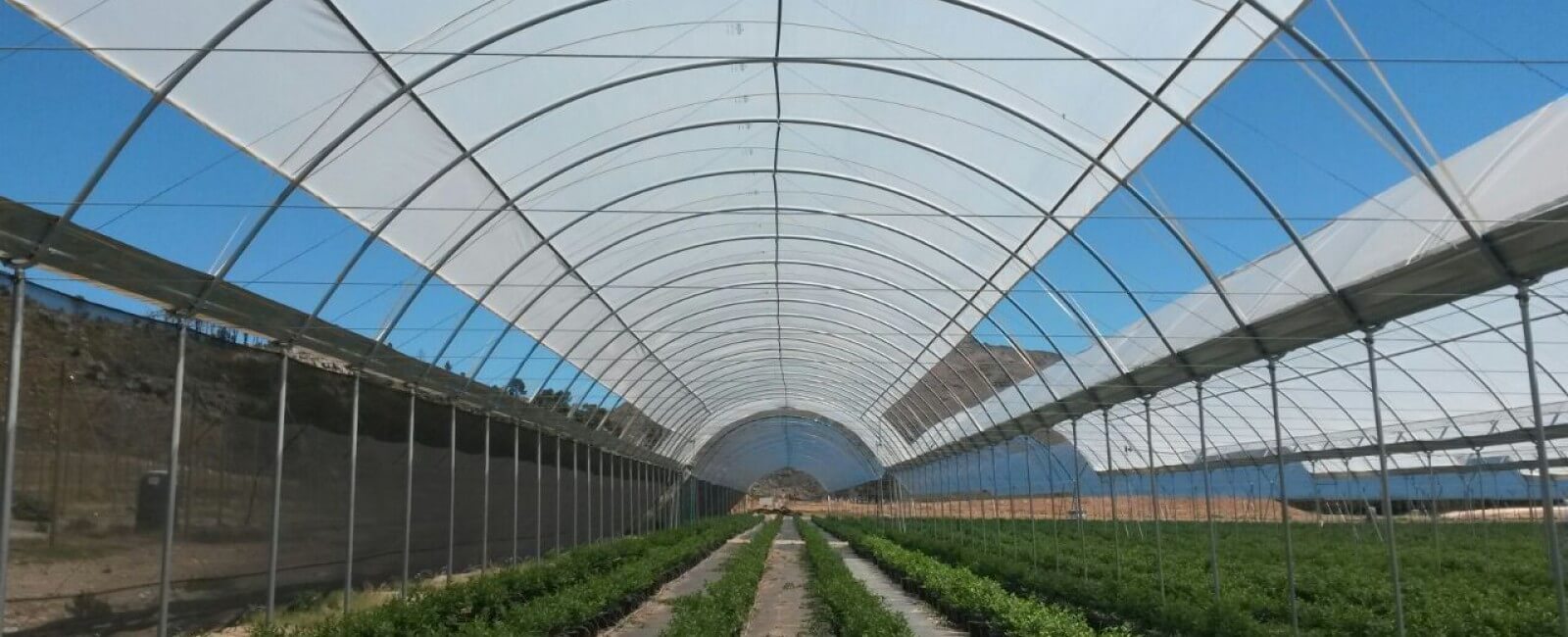
Total Vent, Australia

Play video
Hall Hunter Partnership, UK

Play video

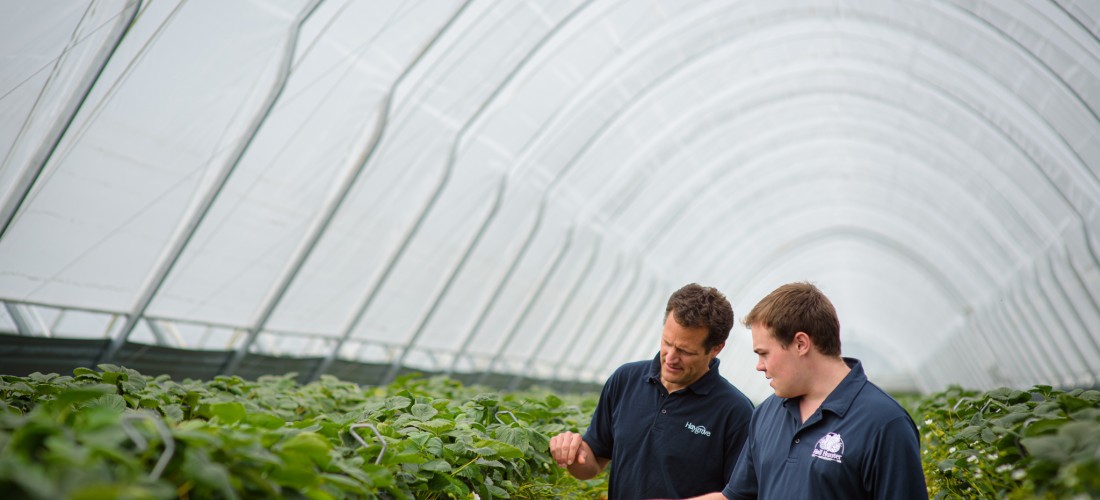
Customer: Hall Hunter Partnership

Location: Berkshire, UK

Crop: Strawberries grown in substrate

Tunnel Type: EZvent

Hall Hunter Partnership are one of Haygrove’s longest standing polytunnel customers, having made their first Haygrove polytunnel purchases over 20 years ago. Today they grow berries across 3 sites in the south-east of England and supply leading retailers with 4500 tonnes of strawberries, 300 tonnes of raspberries and 1500 tonnes of blueberries each year.

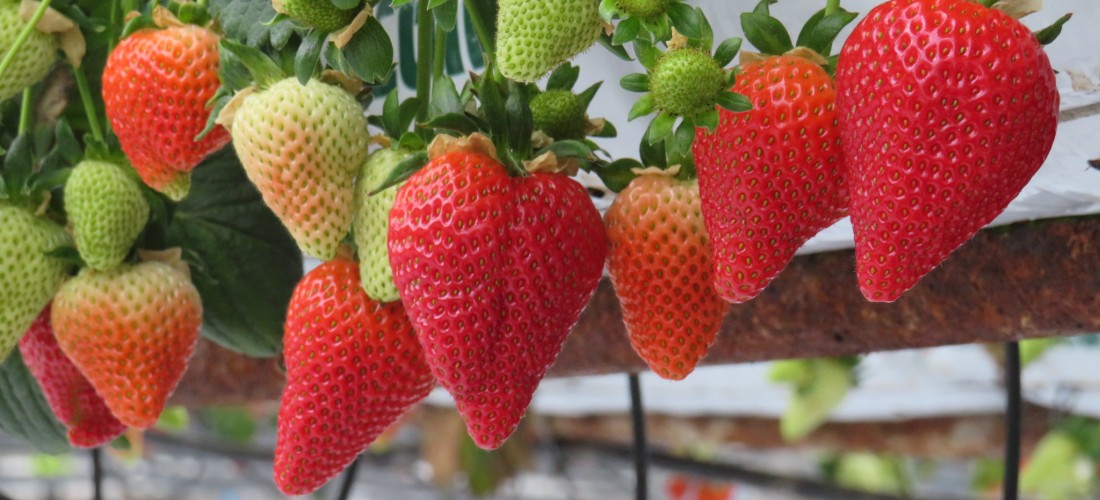
Hugh Leach, Agronomy and Trial Coordinator for Hall Hunter Partnership, explains why they are using Haygrove EZvent polytunnels to manage an optimal growing environment on a field-scale. The EZvent tunnels are being used on the Hall Hunter Partnership trial site where they are growing 48 different varieties of Everbearer strawberries, planted at a density of 6 plants per metre. When testing different varieties, climate management is critical to ensure a fair and valid trial is undertaken within the Haygrove polytunnels.

Key benefits Hugh observes from using the Haygrove EZvent tunnels:

  • The automatic vents mean venting is done at the optimal moment and with sufficient frequency, without accumulating labour costs throughout the season.
  • 20% decrease in fruit wastage in the leg rows from closing the vents to prevent weather damage
  • High air volume buffers the temperature changes giving more consistent growing environment. With tunnels retaining the heat on cooler days and staying cooler on hotter days, resulting in one-week earlier picking than in their standard polytunnels.
Read more about the Hall Hunter Case Study

The EZvent tunnels at Hall Hunter Partnership use 8.2m bays with 6 lines of strawberries grown in substrate tabletop system. The support legs are 1.7m above the ground and drilled 1m into the ground. The drill depth ensures that the polytunnels are securely fixed to the ground to prevent them lifting and causing damage. The 1.7m height of support leg places the vents above the crop height meaning there is effective air exchange to maintain suitable temperature and humidity and helps to reduce disease pressure on the crop.

The apex of the tunnels is 5.5m high. The large air volume within the Haygrove EZvent tunnels means there is a slower rate of change to the temperature in the polytunnel. The large air volume combined with Haygrove Luminance polythene, which diffuses the light and provides a thermal heat barrier, there is a more stable growing environment for the plants which reduces stresses and results in a higher yield of quality fruit.

On a hot day, Hugh has witnessed a 3-degree cooler temperature inside the Haygrove EZvent tunnels compared to outside. Yet on colder days the heat has been retained and there has been a 2-degree increase in temperature in the polytunnels. The reduction in temperature fluctuations means the rate of photosynthesis remains closer to the optimum level and therefore plant growth is maximised.

The Haygrove EZvent tunnels are connected to a Priva climate control computer. There are sensors inside the polytunnels to measure temperature and relative humidity and outside to monitor wind and rain. The vents on either side of the EZvent tunnel can be operated independently. Wind direction and wind speed is measured so vents can be operated on both the windward and leeward side. The computer is set to automatically operate the vents within set parameters of these variables.

Hall Hunter Partnership has found that compared to manual venting, automatic venting with the Haygrove EZvent tunnels is more accurate with timing and happening with increased frequency, which improves the consistency of the internal tunnel growing environment and allows the strawberry plants to thrive. There is no accumulation of labour costs throughout the season on venting tasks. With manually vented tunnels, timing and frequency of venting is often limited by availability and cost of labour which compromises the yield and quality of the plant.

With automatic windward and leeward venting, the vents can be set to parameters that will prevent damage to leg row fruit. When berries in the leg row are exposed to wind or rain, they can be damaged by knocking into other fruits and rain damage compromises crop quality. At Hall Hunter they estimate a reduction of 20% wastage to leg row fruits. This increases overall yield but also increases picking speeds as labour is not wasted on picking and discarding damaged fruit.

The Haygrove rainwater gutters are made from galvanised steel and have multiple benefits. The automatic vents close when there is precipitation meaning that the leg rows or valleys are kept dry. This protects the fruit in the leg rows and prevents excessive humidity building up in the tunnel. The Haygrove rainwater gutters also mean that when the vents are closed there is a large catchment area for rainwater harvesting which can be collected and stored for irrigation.

Hugh concludes by saying ‘Haygrove EZvent tunnels are a great choice for maintaining the optimum growing environment!’

Lower Hope Farm, UK

Play video

Customer: Lower Hope Cherries

Location: Herefordshire, UK

Crop: Cherries

Tunnel Type: Greenhouse

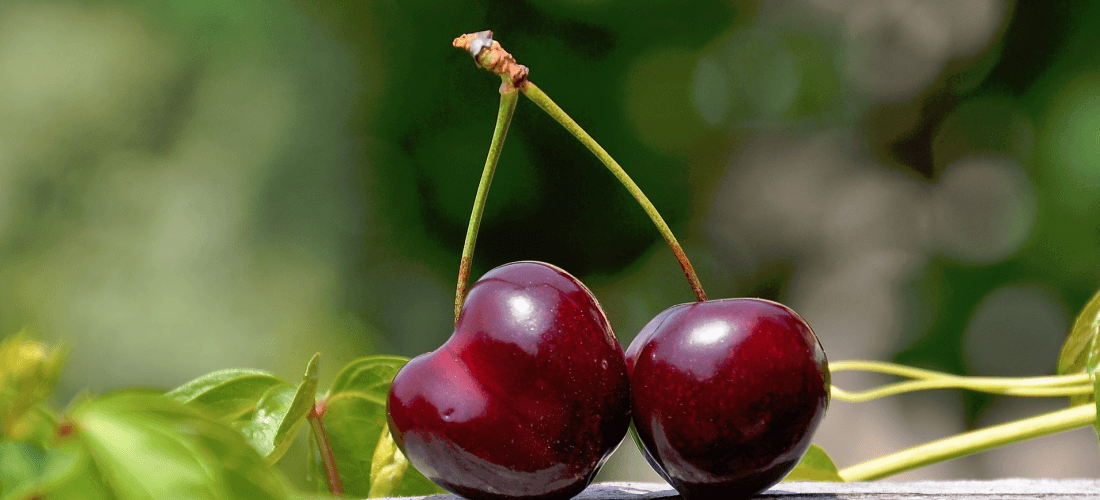
Lower Hope is a long-standing Haygrove customer. Fruit Manager, Emily Cliff, explains the benefits of using Haygrove Tunnels to cover the cherry crop.

Lower Hope Cherries began in 1999 and have continued to grow until the present day. Lower Hope have worked with Haygrove to develop their cropping systems and now work with a standard planting of 1.75m between the trees and 1800 trees per hectare.

They aim for a yield of 10kg per tree giving a Class 1 yield of 18 tonnes per hectare. Using Haygrove polytunnels to cover the cherry trees has increased yield, quality and extended the season. The polytunnels protect the cherry trees from frost when they are most susceptible at blossom time and then protect the fruit from rain and wind damage.

When cherry trees are protected by polytunnels, growers can leave the fruit to grow bigger as there is a significantly reduced risk of cracking. An increased fruit size means an increased yield. The Haygrove polytunnels also protect the ripe berries from birds which if not protect can decimate a sweet cherry crop.
Read more about Lower Hope Case Study

Based on a windy site on a high-altitude hill, it is imperative that the Haygrove polytunnels are strong. The introduction of HSO (High Strength Oval) steel has allowed them to increase their bay width from 6m. Increasing the bay width of the tunnels increases the air volume which improves the growing environment, as well as increasing planting density and reducing the amount of fruit in the leg rows. Increasing the strength of the tunnels has allowed Lower Hope to skin (cover the tunnels with polythene) earlier in the year as the increased strength means there is less risk of storm damage. Being able to skin the Haygrove polytunnels earlier means that there is a better frost protection for the trees at blossom time.

Lower Hope began using Haygrove Pioneer tunnels which have a Y-shaped leg but now use a U-leg. The U-leg is the key feature of the Haygrove Greenhouse tunnel and is specially designed for tree and cane crops. The hoop rises vertically giving more space higher in the tunnel which is needed for taller plants or trees. The support legs are 1.75m out of the ground which gives adequate space for the trees but also means that the tunnels can be manually vented by teams of labour working at ground level and the apex remains relatively low at 4m high. The support legs are drilled 0.85m into the ground ensuring the polytunnels are well secured to prevent lifting.

Lower Hope Cherries are using different Haygrove polythene films to manipulate the timing of the crop. By managing the harvest timing, they can target points in the season when the price is highest and spread their picking profile to efficiently use their workforce.

To achieve a later sweet cherry harvest, Lower Hope use a woven material with a net at the apex which provides a permanent vent, but still protect the fruit from weather damage. This means the humidity and temperature of the tunnel remains cool throughout the summer, but without an accumulation of labour costs from venting. Emily observes a difference of a week in the picking time between using this woven material cover on the Haygrove polytunnels compared to the Luminance polythene. Combined with a high-altitude site, Lower Hope grow some of the latest season cherries in the UK meaning they can access higher market prices when supply is lower.

For mid-season crops they are using our Luminance polythene, which has 95% diffusing properties for even light distribution and deeper crop penetration. The Luminance plastic also provides a ‘Thermal Heat Barrier’ which reduces the amount of infrared light able to pass through. This keeps internal environment of the tunnel cooler on hotter days and retains heat on warmer days, reducing temperature fluctuations which stress the trees and cause a reduction in yield.

For early season crops, Lower Hope are using Haygrove Clear polythene which has the highest light transmission and therefore fruit can ripen quicker and is ready to harvest earlier.

Lower Hope can spread their sweet cherry harvest season by using polythene technology options supplied by Haygrove. An even distribution of the cherry season is an efficient use of labour which is both increasing in cost and decreasing in availability. The ability to manipulate the harvest also means Lower Hope can target seasonal gaps in the UK supply. When there is the lowest supply there is the highest demand for Class 1 cherries and therefore highest market prices.

Lower Hope and Haygrove will continue to collaborate to develop cherry growing systems in the future.

Clock House Farm, UK

Play video

Customer: Clock House Farm

Location: Kent, UK

Crop: Strawberries in Substrate

Tunnel Type: Ventura

Substrate Gutters: C160 profile on tabletops

As one of the largest UK berry producers, Nick Deppe Production Director, talks through how they are using Haygrove products to achieve their efficiency targets.

Clock House Farm were one of the pioneers of growing strawberries in substrate on a commercial field-scale with the first substrate systems being purchased in 1998. By 2006 they had completely converted their production to be out of the soil.

There are 6 lines of tabletops in each 9m wide Ventura polytunnel, which are split by a central alleyway where machinery can drive. By having an even split of 3 rows either side, the crop can be sprayed in one-pass in either direction, without having to adjust the sprayer settings. The tabletop strawberries are constructed at 1.1m height, a comfortable height for workers to pick well-presented fruit meaning high picking speeds are achieved.

Haygrove’s strong HSO steel has given Clock House the confidence in the strength and stability of the polytunnel to increase the bay width to 9m with 6 rows of substrate gutters per tunnel, whereas previously they worked on a 4-row system in a 6.5m wide tunnel.
Read more about the Clock House Farm Study

There are multiple benefits to increasing polytunnel bay width. Firstly, less time is spent spraying as not so many passes are needed. Secondly, a wider bay width reduces amount of fruit exposed to the weather in the leg row valleys. Thirdly, a wider bay width reduces number of operational tasks such as venting to be done in the leg row and reduces construction and re-covering time.

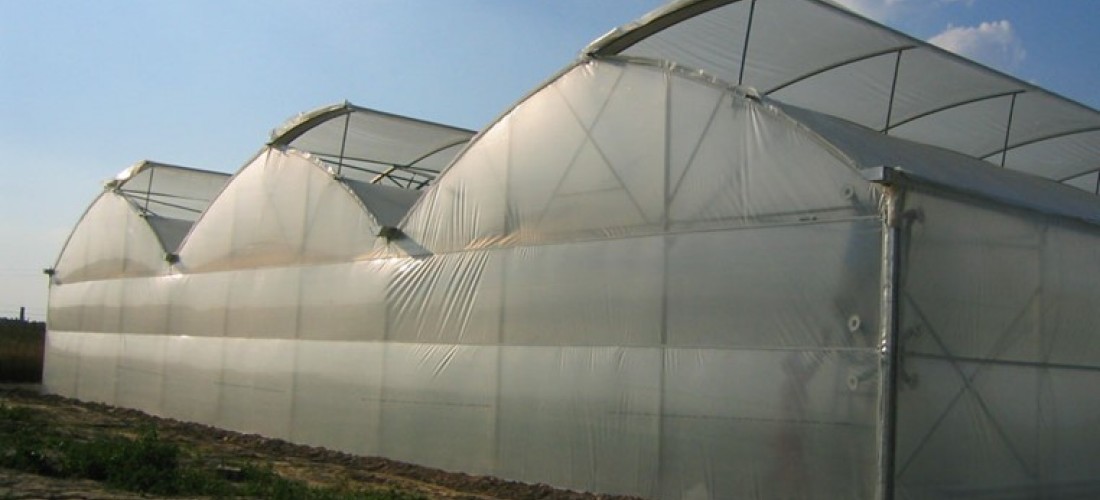
The Ventura hoop shape and the unique v-leg means the plastic covers can be pushed up and securely fastened for most of the season. As Ventura tunnels are not designed to be regularly vented, labour costs from venting are avoided but the crop is not severely compromised from weather damage due to the positioning of the vents. Combined with hoop shape and the 1.2m spacing from the support leg to the tabletop crop, less of the crop is exposed when the vents are open than would be on a Pioneer polytunnel. The designated space at the sides also makes it easier for husbandry, with space for workers and machinery, such as grass mowers. Haygrove Ventura polytunnels are an excellent choice for a basic tunnel covering over a mid-season crop.

To cover the Haygrove Ventura tunnels over a mid-season everbearer strawberry crop, Clock House Farm are using a Luminance 55 polythene film. This diffuses 55% of light which is enough to scatter the light on a bright sunny day but does not compromise growth on a lower-light cloudy day. This polythene film is a halfway product between our Clear (high light transmission) and Luminance (high diffusion) polythene options. It is well suited to the UK climate and mid-season everbearer growing requirements at Clock House Farm.

The polythene is the Haygrove standard thickness of 150mu and designed to last 3 seasons in the UK, although Clock House are not unusual amongst growers finding that their Haygrove polythene lasts about 5 seasons.

On a different site to the Ventura tunnels, Clock House Farm have a block of automated Haygrove ProVent tunnels. These are permanent tunnels that are covered all year round. Here the vents are connected to climate control computer and sensors. The wind sensors are set to close when the wind speed reaches 15 miles per hour, meaning the crop is quickly protected. There are multiple benefits to using automated venting Haygrove polytunnels, managing temperature and humidity, protecting the crop from wind and rain damage, and labour efficiency. Workers are not required so can be used more efficiently on other tasks.

Increased investment in automation is leading to better control of the climate, better crop protection and more efficiency with labour on farm. Roller doors are connected to 24volts motors meaning 1 person can operate 50m of Haygrove roller door at one time. As well as access to the polytunnels, the roller doors are used as a vent to prevent temperature and humidity rising too high and closed to seal the polytunnels on cooler nights.

An additional benefit of the permanent ProVent tunnel that is covered all year as the grass in the alleyways does not receive any water, it does not grow and therefore does not need to be mown. It is another labour saving and helps to make the Clock House Farm more efficient.

The ProVent tunnel has a high air volume which reduces temperature fluctuations and creates a more stable growing environment and a good air flow for the plants to thrive.

Double Skin, Haygrove UK

Play video

Customer: Haygrove UK

Location: Herefordshire

Crop: Strawberries in Hanging substrate gutters

Tunnel Type: Serra Series - Double Skin Tunnels

Substrate Gutters: C160 profile with substrate bags

Fundamental to Haygrove's innovation is maximising the synergy of our farm and growing systems teams by sharing knowledge across specialisms and hemispheres. The collaboration means we can innovate fast and rigorously test products on our own farms to optimise the natural environment for maximum productivity and quality of crop. For the Serra Series Double Skin Tunnel Haygrove are partnering with GeoGroup to supply this poly greenhouse.

Daniel van der Veen, Head of Innovation at Haygrove, explains why Haygrove have chosen the Serra Series Double Skin tunnel as an alternative for a glasshouse to provide season extension on our own Haygrove farm. The aim is to produce 55 tonnes per hectare of strawberries in a double cropping system at the beginning and end of the season when market prices are highest.
Read more about Double Skin Tunnels at Haygrove

The heavy tray plant Malling Centenary crop is planted at the beginning of January, in the UK winter, on a spacing of 12 plants per metre. Each plant is expected to produce about 550 grams. The objective is to pick the crop at the end of March and again in October, at the same time as glasshouse production, and with the same yield, but with a fraction of the capital infrastructure investment.

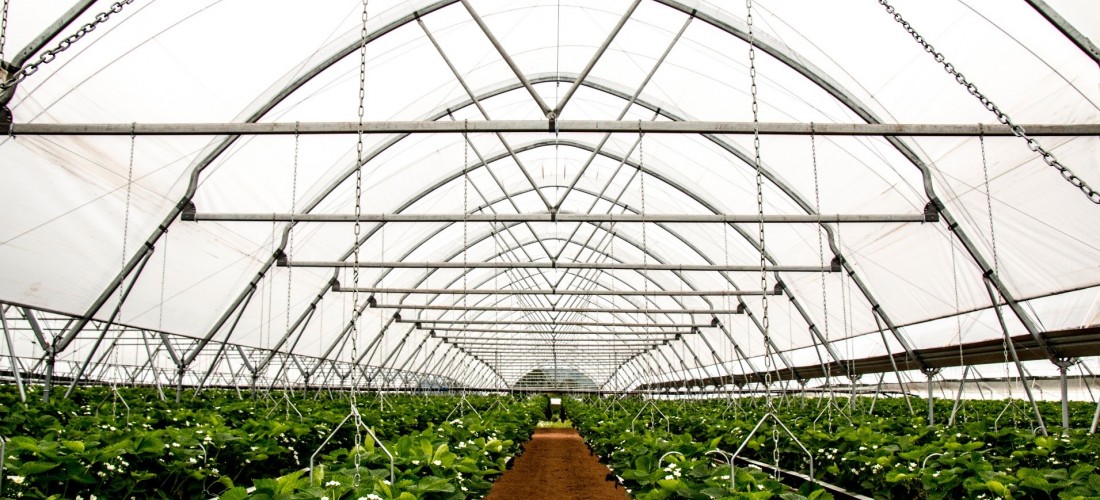
The tunnels are 9.6m wide with 4 metres to the gutter height. In each polytunnel are 8 rows of hanging substrate gutters for strawberry plants with a middle track to take the fruit to the packhouse. The venting is done through a double butterfly vent at the apex that operates on a rack and pinion system and a roller side vent on one side, both are connected to the climate control computer and operate automatically within the set parameters.

Studies have shown double skin tunnels are 40% more efficient at retaining the heat as a standard glasshouse without thermal screens. The light transmission in this tunnel uses the latest technology and through both layers is 82%. Haygrove are measuring light levels using sensors placed throughout the tunnels and comparing this to natural light levels outside. The data is stored on the cloud and can be checked monitored on mobile phones and tablets, similar to the technology available in a glasshouse.

The double apex vent and side vents are linked to climate control computer to automate venting based on temperature, humidity, carbon dioxide levels, precipitation, and wind speed and direction to optimise the internal environment of the polytunnel both for yield and pest and disease control.

The Serra series on the Haygrove farm is heated using a gas air heater. If installing over a bigger area, Daniel recommends using heating pipes at ground level for a more even heat distribution making it a more efficient way of managing a consistent climate.

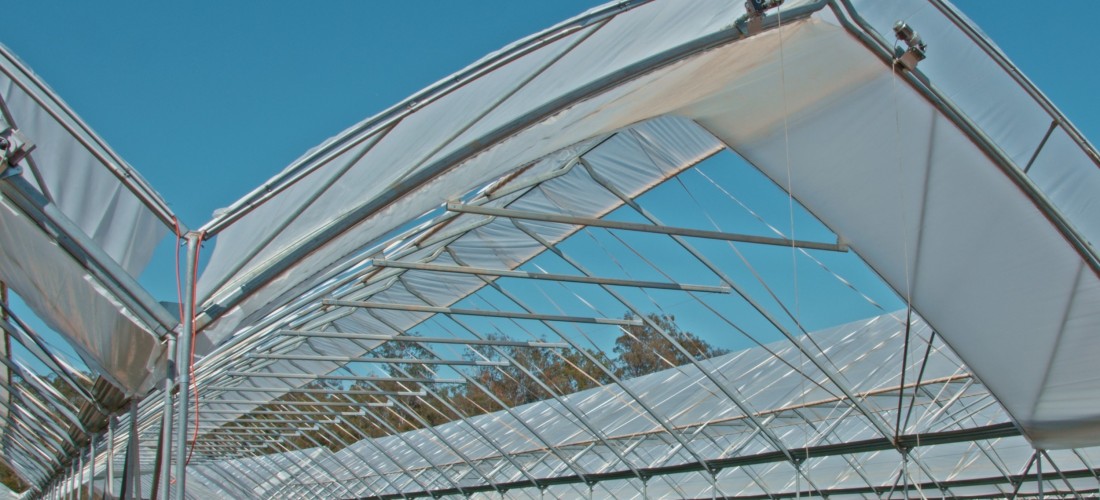
EZvent, Haygrove UK

Play video